






















How AI Difficulty Adjustment Is Changing Single-Player Mobile Games
Single-player mobile games have entered a new era. In 2026, the biggest change isn’t just better graphics or faster performance—it’s AI-driven difficulty adjustment. Instead of forcing players into fixed difficulty levels like “easy,” “normal,” or “hard,” modern mobile games now adapt in real time to how each player actually plays.
This shift is quietly transforming single-player gaming, making games more personal, less frustrating, and far more engaging.
What Is AI Difficulty Adjustment?
AI difficulty adjustment, often called dynamic difficulty adjustment (DDA), uses artificial intelligence to analyze a player’s behavior and adjust the game’s challenge accordingly.
The system tracks things like:
- Player reaction time
- Success and failure rates
- Decision-making patterns
- Time spent on levels
- Repeated mistakes
Based on this data, the game subtly changes enemy strength, puzzle complexity, speed, or rewards—often without the player even noticing.
Why Fixed Difficulty Levels Are Failing Players
Traditional difficulty settings assume all players fit into clear categories. In reality, players improve over time, struggle with different mechanics, and play in varying moods or environments.
Fixed difficulty often leads to two problems:
- Games become too easy and boring
- Or too hard and frustrating, causing players to quit
AI difficulty adjustment solves this by evolving alongside the player instead of locking them into a static experience.https://www.gdcvault.com
A More Personalized Single-Player Experience
In 2026, personalization is one of the biggest expectations in gaming. AI-driven difficulty makes single-player games feel tailored to the individual.
For example:
- A beginner gets more forgiving enemies and hints
- A skilled player faces smarter AI and tighter challenges
- A tired player gets slower pacing and fewer punishments
This creates a game that feels designed specifically for you, not the average player.
Reducing Player Frustration Without Killing Challenge
One of the smartest benefits of AI difficulty adjustment is how it reduces frustration without removing challenge. Instead of punishing failure, the game gently adapts.
If a player fails repeatedly:
- Enemy damage may slightly decrease
- Extra resources may appear
- Timing windows may widen
If the player performs well:
- AI becomes more aggressive
- Levels introduce new mechanics faster
- Rewards scale more competitively
The result is a smoother, more satisfying gameplay loop.
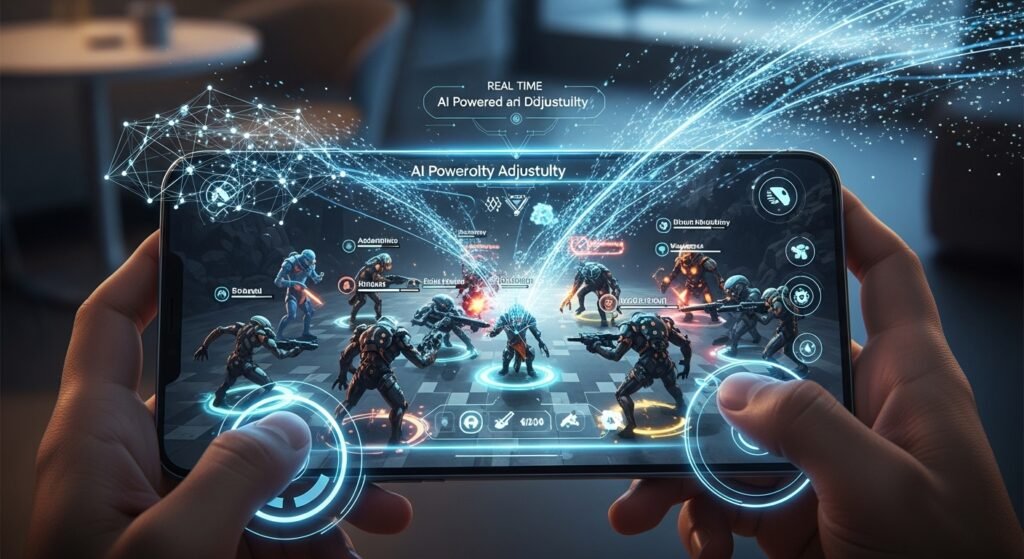
Why This Is Perfect for Mobile Gaming
Mobile gaming happens in unpredictable environments—commutes, breaks, travel, or short sessions. Players may be distracted, rushed, or tired.
AI difficulty adjustment fits mobile gaming perfectly because it:
- Adapts to short play sessions
- Handles interruptions gracefully
- Keeps progress meaningful even in brief gameplay
This flexibility is crucial for single-player mobile games, where players may stop and start frequently.
Smarter Enemies, Not Just Stronger Ones
In older games, difficulty usually meant stronger enemies with more health. In 2026, AI difficulty focuses on behavior, not brute force.
Enemies may:
- Learn player attack patterns
- Change positioning strategies
- React differently to repeated tactics
This makes games feel more intelligent and less repetitive, even in single-player modes.https://viralblogs.net/2026/02/09/how-mobile-games-adapt-to-players/
Keeping Casual and Hardcore Players in the Same Game
One of the biggest advantages of AI difficulty adjustment is that one game can now serve many audiences.
Casual players enjoy:
- Relaxed pacing
- Forgiving mechanics
- Stress-free progress
Hardcore players enjoy:
- Deeper systems
- Tactical enemies
- Meaningful mastery
AI allows developers to support both without splitting the experience.
Improved Retention and Player Loyalty
From a developer perspective, AI difficulty adjustment significantly improves player retention. Players are less likely to quit when the game feels fair and responsive.
In 2026, many single-player mobile games use AI difficulty to:
- Reduce early-game drop-off
- Encourage long-term engagement
- Increase replay value
A game that adapts keeps players invested longer.
Invisible Design: Players Feel It, Don’t See It
One key design principle of AI difficulty adjustment is invisibility. Players shouldn’t feel the game is “cheating” or helping too much.
The best systems:
- Make changes gradually
- Avoid obvious difficulty spikes
- Preserve the feeling of earned success
When done right, players simply feel that the game is “well balanced.”
Ethical Design and Player Trust
As AI becomes more involved in gameplay, ethical design matters. Players want transparency and fairness, not manipulation.
Responsible developers ensure that:
- AI difficulty doesn’t push monetization
- Success still feels earned
- Player data is handled responsibly
Trust is essential, especially in single-player experiences.
The Future of Single-Player Mobile Games
AI difficulty adjustment is just the beginning. Future systems may include:
- Emotional awareness (stress, frustration)
- Voice or gesture-based adaptation
- Learning across multiple games
Single-player mobile games are becoming smarter, more human, and more responsive.
Conclusion
AI difficulty adjustment is changing single-player mobile games by making them more personalized, fair, and engaging. Instead of forcing players to adapt to rigid systems, games now adapt to players.
In 2026, the best single-player mobile games aren’t just challenging—they’re intelligent companions that grow with you. This evolution is redefining what mobile gaming can be.